Showing posts with label Learning. Show all posts

Tuesday, March 8, 2022

Science of Relations: Part 3 FREE RESOURCES

 Charlotte Mason Resources


If you would like to explore more how the educational philosophies of Charlotte Mason fit into the Patristic wisdom of the Orthodox Church, Elizabeth Davis has collected some presentations at Paidea Classics


Part I - Charlotte Mason's Thoughts on "Home Education" In the Light of the Teachings of Our Holy Fathers and Mothers

Part II - Charlotte Mason's Twenty Principles in the Light of Our Holy Fathers and Mothers

Part III - A Lifestyle of Learning Approach to a Classical Style of Education

You can also download those slideshows as pdf versions.


Mind to Mind, a thoughtful abridgement by Karen Glass, is an easy read and a good choice if you don’t have time or care to read all of Charlotte Mason’s books but are interested. It’s her last book, the one she wrote after decades of experience teaching, in which she sharpens and refines her thoughts on education.


Don’t have time to read a book about Charlotte Mason’s educational theories, but could listen to a podcast while you fold laundry or commute to work? Cindy Rollins has a new podcast, The New Mason Jar that has been comforting to me, comforting in making me feel like yes, I can do this! Cindy and various guests – mothers who’ve been doing this a while – talk about what education looks like played out in real life with real mothers and real kids.


Myths, Fairy Tales, and Church Fathers


The Church Fathers read myths? Actually, yes, many of them did. And they saw images of Christ embedded in stories. Justin Martyr calls these images “seeds of truth.” If this idea interests you, you might like to listen to Why Read Pagan Myths where I first heard this phrase - seeds of truth.


This article about St. Justin the Philosopher and Martyr from Orthodox Christian Fellowship articulates some of these ideas I have been trying to grapple with about creation, patterns, and Christ the Logos. It also links to the full text of St. Justin’s writing in which he mentions seeds of truth.


The Literary Life Podcast is free and if you scroll through the archives you might be delighted to find a discussion on a short story or Shakespeare Play you plan to read with your children or an idea you would like to think more about.


Not-Free Resources

(But worthwhile “Professional Development”)


I am currently taking a class from the House of Human Letters on How to Read Fairytales and it is very helpful in learning how to see the images! It is the reason I understood the thorns, the lips, the life in Sleeping Beauty, and most of my thoughts in this series came from this class combined with my spiritual reading. It turns out that most people in the Middle Ages knew what all the symbols were and what they meant, but we’ve lost quite a bit of that now. House of Humane Letters offers lots of “live or later” courses and webinars. 


From the Archives

Sunday of Orthodoxy is coming up this weekend. Here are some coloring pages and handwriting sheets to help your kids become more aware of this first Sunday of Great Lent.


For a look at real, live, not-perfect crafting and connections with little ones, here’s a science activity: STREAM - Creation and Chocolate. I know, I know: in this activity I helped them make the connections, after I told you not to make the connections for them. What can I say, sometimes an artsy gal is called to teach science and do a craft. In that case, one just makes do.


Here are the other posts about Science of Relations:

1.     Science of Relations: Delightful Connections

2.     Science of Relations: For all of Us (not just homeschooling mamas)


Wednesday, February 23, 2022

Blindness and Seeing (Science of Relations: Part 2)

Why should I care about "Science of Relations?"


As an Orthodox Mother, one of my life struggles is to rightly see the contours of reality and to help bring my children to be able to see too. I got that idea about needing to develop the “contours of reality” from Bishop Irenei in The Beginnings of a Life of Prayer


It’s one of those books, like The Philokalia, that I can read only a couple of paragraphs at a time. And then I have to read those same paragraphs over and over, over the course of several days. Of course, those are just MY current readings. 

If you are wondering what YOU should read, ask your priest! 😀

But let’s get back to BLINDNESS and SEEING. Think of all the times Jesus encountered blind men in the Gospels. It was not only because those particular men needed physical sight. It is because we are all blind - spiritually blind - and need new sight. 


Obviously, the most important way to get this true sight is living the life of the Church: Prayer, Sacraments, Scripture, Lives of the Saints, Alms-giving, Fasting, etc.


But in addition to the Life of the Church, it seems that God in his mercy gives us art as a means of seeing reality. In times prior to our Modern Life, this is what art meant to do - portray reality through patterns. 


Musical patterns, nature patterns, image patterns, story patterns. 


When oral traditions of storytelling - from all over the world - end up repeating the same patterns and images, it is not because people just happen to find comfort somehow in these images. It is because they are glimpses of true TRUTH embedded within the creation, truth that can’t help but come out.


In this fallen world, we see only in shadow. In our own society, people no longer look to religion to tell what is true. Mankind can do it! 

I taught public high school for ten years and my students often voiced this desire. I once had a young man, bright of mind, slight of stature, a 9th grader with his dark bangs hanging over his eyes, explain it to me perfectly: “The Scientific Method is my measure of reality. If I can’t see it, taste it, smell it, touch it, or hear it - it doesn’t exist.”


It’s pretty hard to see the unseen if that is one’s idea of reality!


You might be thinking, that’s too bad for that kid, but I’m an Orthodox Christian. I know unseen reality exists.

True, but I think it would be fair to assume that as members of our age, our way of seeing is effected by the ways of thinking around us. We swim in the pool of our times. And there is pee in the pool. It's hard to avoid. 

But we can try to draw our minds back to reality. We can experience the unseen as incarnated patterns in paintings, music, and stories: like in thorns, a touch, lips, and life. Embedded in a fairytale, we find images of sin and death, the Body and Blood of Christ, and Life.

As a human person, much less a particular kind of person called an Orthodox Mother, it’s worth paying attention to life and looking at God’s creation, along with the creations of His creations. 


Our children are going to read something. Listen to something. Look at something.  It’s worth putting true stories and music and art in front of them.

And then paying attention to them.

And being open to what we see. 

And what connections we see between them.

Snow White


Next time I will share with you a whole basketful of cool resources to learn more about fairytales and the science of relations. For now, I hope you enjoy your own delightful connections that pop up in this whole big world of God’s. Open your eyes to notice them!


Wednesday, February 2, 2022

Science of Relations: Delightful Connections

The other day I was reading a paragraph of the Little Russian Philokalia and I gasped! Right there in front of my eyeballs I was seeing the same images I had just seen in the Grimm brothers’ version of Sleeping Beauty (originally called Little Briar Rose). 

I enjoyed a little rush of excitement and shook my head once again at the connection. What did I see?

Both writings share these words: 


thorns, touch, lips, life


In the original Sleeping Beauty she herself is cursed, but the curse also affects the world around her. The servants fall asleep, the horses fall asleep, and even the land is cursed with thorns surrounding the castle. 


 Only the son of the King can reverse the curse.


When the True Prince traverses the thorns, they transform into flowers. When the prince touches her lips with a kiss, the curse is broken and she awakens to new life


In The Little Russian Philokalia, Volume 2, Elder Nazarius is writing advice to his monks and says that the Body of Christ will “consume all your sinful thorns which grow in you… as soon as you see the priest’s hand stretched out with the Holy Sacrament and touching your lips… picture and believe with your whole soul that you receive it from the hand of Christ Himself, Who stands invisibly and places it within your mouth… (giving you) life” (pg 66).         


Image from St. Nicholas Orthodox Church in McKinney, TX


What exactly is the Science of Relations? 

It’s just a name for something we all do anyway, if we have eyes to see and ears to hear. We notice connections between things. And this is normal! We should notice the connections because everything is connected! All of creation is organized by God as one big WHOLE and all the sub-creators within it are a part of that creation. 

The term “Science of Relations” is the name British educator Charlotte Mason gave to this connection-making.

Ambleside Online explains: “Charlotte Mason defined education as a series of relationships formed by the learner as he developed intimacy with a wide range of subjects - something she called "The Science of Relations." 

A series of relationships formed by the learner. That’s me - I’m the learner. 


I read a fairy tale one day.

I listen to a podcast or take an online class to dig deeper and take special notice of some images. 

The next day I read from the Philokalia and see the same images. 

I relate the fairytale to the Eucharist.

I write a blog post and in writing remember Jane Meyer’s book The Man and the Vine and how when the little girl took communion, the “love filled her mouth”


All these connections add meaning to what I read and think and my understanding of the world and reality grows.


The love of the Son of the King touches my lips and I am saved from the sinful thorns of death and given life!


Of course, I’ve been talking about me, not just my children. As I heard at the end of The New Mason Jar podcast, “children are born persons, and so are their moms."

We all get a lifetime of education!

What about you? What delightful connections have you made recently? I would love to hear them!


Monday, August 13, 2018

Catechism for Ancient Literature and History - Age of the Patriarchs


Inspired by Joshua Gibbs, I have undertaken to write a similar text for oral recitation for our Homeschool this year. We are studying the Ages of Grace cycle entitled Age of the Patriarchs,
using the Prologue schedule, and the K-1st Grade Reading List available in the Ages of Grace facebook group and whatever materials we can create -- like this High School Curriculum.
What you see below is a work in progress and I welcome feedback from other parents and teachers.

My children range from ages six to fifteen, so I have revised this mini-recitation within the
larger one for the six-year old. He will just stand with us and listen to the rest.


Students stand and read aloud in unison, each from their own copy. However, the teacher says the Elementary timeline and the students repeat it.


When is Ancient History?
Our Ancient History covers roughly 6000 years before the time of Christ - Before Christ is shortened to BC.

What is the Elementary Timeline? (with hand motions)
Creation, Fall, Flood over all                      (Children Echo)
2000 BC Abraham, Isaac Jacob                    (Children Echo)
1000 BC Joseph, Egypt, Slavery, Moses                 (Children Echo)
Joshua-Conquest, Judges                     (Children Echo)
Kings, Divided Kingdom                         (Children Echo)
700 BC Exile to Assyria - Homer writes Epics in Greece        (Children Echo)
600 BC Exile to Babylon - Daniel and the 3 Holy Youths        (Children Echo)
500 BC Return under Persia                     (Children Echo)
Shhh.. 400 years of silence from the Bible             (Children Echo)
Meanwhile.... 300 BC Alexander the Great             (Children Echo )
100 BC The Roman Empire                    (Children Echo )
20 BC Virgil writes his stories                    (Children Echo )
Anno Domini - follow that star - in the Year of our Lord        (Children Echo )

What is the Upper School Timeline?

2300 BC The Flood destroys all but Noah and the Ark
2100 BC Job suffers long
2000 BC  Abraham the Patriarch follows God to a new land

There he begat Isaac, who begat Esau and Jacob, who begat 12 sons, one of them Joseph, who was sold into slavery in Egypt and joined by his family in 1670 BC.

1550 to 1069 BC  Egyptian Empire reigns
1445 BC Moses leads God’s people out of Egypt

1405 BC Joshua leads the people into the Promised Land
1398-1050 BC The Judges rule Israel

1050 BC Israel’s first King - Saul - is annointed followed by David and Solomon.
930 BC Israel is divided into two kingdoms.

884-612 BC Assyria is a world empire
723 Israel is taken captive to Assyria and the prophet Isaiah lived.
700-800s BC Homer - in Ancient Greece - wrote down the epic stories his people passed on from generation to generation around campfires - The Iliad and The Odyssey.

612-539 BC Babylon is a world empire and attacks Jerusalem, Daniel and the three Holy Youths are taken captive to Babylon, Hezekiah and Jeremiah lived, and the book of Ezekial was written.
539-331 BC Persia is a world empire, and the Israelites return home to re-build the temple. This is the time of Ezra, Esther, and Nehemiah.

400s-500s BC, Ezra and the Great Assembly complete the canonization of the Old Testament.

400s BC Theatre is born as Sophocles writes his famous Oedipus plays to entertain and instruct worshippers gathered at the temples of Greek gods and goddesses for feasts.

336-323 BC Alexander the Great builds and rules his Macedonian Greek Empire.

63 BC Roman troops occupy Judea and Jerusalem falls.

44 BC Julius Caesar is assassinated.

37 BC Herod becomes King of Judea through Rome.

27 BC Roman Empire rises.

Around 20 BC, Virgil writes the epic poem, The Aeneid.

Around the year 1 - Anno Domini - The Year of Our Lord - Christ is born!

We shorten Anno Domimi to AD


How did our Lord Jesus use the Old Testament?
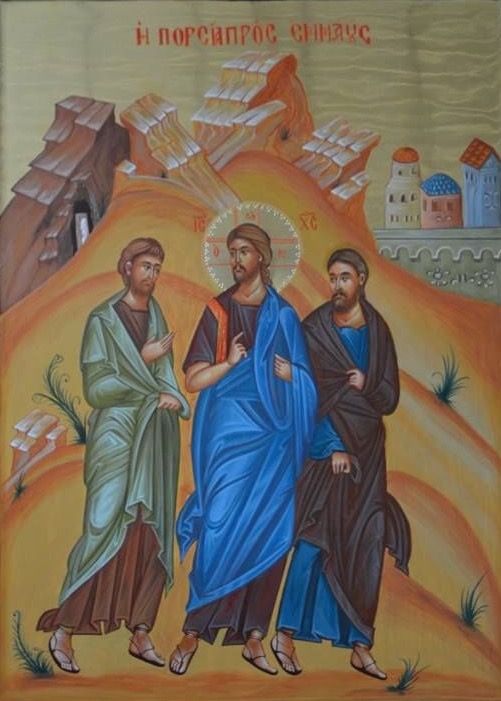
Image result for road to emmaus orthodox icon
Beginning at Moses and all the prophets, Jesus expounded unto them in all the scriptures the things concerning himself.
How do we as Christians use the Old Testament?
We see Christ.
Also, we find in the Old Testament an opportunity for repentance and for spiritual encouragement.
For repentance - we see ourselves in the sins of the people, as we pray in the C anon of St. Andrew: “Like the Israelites in the desert, thou hast made a foolish decision, O my soul; for thou hast preferred the pleasures of gluttony and passions to the refreshment of divine manna.”
For encouragement - we find examples to inspire us in our spiritual life: “The ladder seen of old by the great Patriarch Jacob is an example, O my soul, both of ascent through action and of ascent through spiritual understanding. Watch, O my soul, and take courage like the Great Patriarch Jacob of old, that thou mayest acquire action with spiritual understanding, and be named Israel, ‘the mind that sees God’; and so shalt thou penetrate the impassable darkness through contemplation, and obtain a great treasure as thy reward.”
What are the chief aids to opening our hearts to this great treasure?
    Prayer, fasting, performing spiritual and corporal works of mercy.
How should Christians read the literature of the pagans?
St. Basil suggests that “Since the life to come is to be attained through virtue, chief attention must be paid to those passages in which virtue is praised. In the pagan literature virtue is lauded in deeds as well as in words, wherefore one should study those acts of noble men which coincide with the teachings of the Scriptures. Young men must distinguish between helpful and injurious knowledge, keeping clearly in mind the Christian's purpose in life.”
What is the Christian’s purpose in life?
Our purpose is to be unified with God, to become truly human, acquiring the mind of Christ.
What does School have to do with this?
School is a tool to seek the infinite God in the world He created, to learn the ability to see reality and the habits that are required to live within reality (and not to fight against it)*. School can be a part of our transformation, our theosis.

Since it is so easy to lose focus on this, what must we do?
St. John of Kronstadt explains, ““The Christian, who is called to a heavenly country, who is only a stranger and a sojourner upon earth, ought not attach his heart to anything earthly, but should cling to God alone, the Source of life, our resurrection, and the Life eternal.”
“We are Achaians coming from Troy, beaten off our true course by winds from every d irection across the great gulf of the open sea, making for home.” Homer- The Odyssey

What are the virtues that will enable us to attain the life to come, our eternal home?
Humility, Generosity, Chastity, Gentleness, Temperance, Joyfulness, Diligence
What are the vices?
Pride, Anger, Greed, Sloth, Lust, Envy, Gluttony
What might we tell ourselves when we get angry?
“Still, we will let all this be a thing of the past, though it hurts us, and beat down by constraint the anger that rises inside us. Now I am making an end of my anger. It does not become me, unrelentingly to rage on.” ― Homer, The Iliad
How should we strive?
    Elders Barsanuphius and John encourage, “We are praying for you; and do you, according to your strength, acquire humility and submission. Do not insist on any occasion that it should be done according to your will, for from this anger is born; do not judge and do not belittle anyone, because from this the heart grows faint and the mind is blinded, and from this negligence appears and unfeelingness of heart is born. Keep ceaseless vigil, learning in the law of God, for through this the heart is warmed by heavenly fire; do not be despondent and do not weaken. God does not demand of you what is beyond your strength, but demands labor to the extent possible.”
“Let me not then die ingloriously and without a struggle, but let me first do some great thing that shall be told among men hereafter.” ― Homer, The Iliad
What if we don’t want to struggle?
“The gates of Hell are open night and day; smooth the descent and easy is the way.”
“Even his griefs are a joy long after to one that remembers all that he wrought and endured.”
“The best things, the things we treasure most, come through difficulties. If we ignore the
difficulties, we are neglecting the true joys.”
His Eminence, Metropolitan JOSEPH

How can we acquire humility?
    O Jesus meek and humble of heart, hear me:
From the desire of being esteemed,
From the desire of being loved,
From the desire of being sought,
From the desire of being honored,
From the desire of being praised,
From the desire of being preferred,
From the desire of being consulted,
From the desire of being approved,
Deliver me, Jesus.
From the fear of being humbled,
From the fear of being despised,
From the fear of being rebuffed,
From the fear of being calumniated,
From the fear of being forgotten,
From the fear of being ridiculed,
From the fear of being wronged,
From the fear of being suspected,
Deliver me, Jesus.
That others may be loved more than I,
That others may be esteemed more than I,
That others may grow in the opinion of the world and I diminish,
That others may be chosen and I set aside,
That others may be praised and I unnoticed,
That others may be preferred before me in everything,
That others may be more holy than I, provided I am as holy as I can be,
Jesus, grant me the grace to desire it.

   
*This is from Andrew Kern's podcast Ask Andrew. I didn't make the kids memorize his name but I do want to give him credit for the lovely idea.