I promise, you could just follow my own family's plan and get a good taste of a Shakespeare play.
However, you might like to go deeper for a number of reasons:
1. You are just curious.
2. You are nerdy like me and like going deeper to see more ideas.
3. You would feel better about answering your children's questions if you had a little more preparation yourself. This one might especially be true if your child was assigned Shakespeare in school and you want to be able to participate and/or help at home.
4. You want to learn more about a specific play in order to decide if it is appropriate for your family.
If any of these resonate with you, then this post is for you. I'll start with Free Resources, and then move to Paid Resources. Remember - not everything I list will be appropriate for your children. This list of resources is really for you as a parent.
Free Resources for Shakespeare
If you can, start with the Lamb's version.
Then move to
the play itself. I linked to their
Romeo and Juliet, but you can find most of the plays there. Just type Shakespeare into the search bar.
The Play's the Thing Podcast - best free place for understanding the histories and tragedies
This podcast goes through Shakespeare plays one act at a time. The rotating hosts are all literature teachers and Shakespeare lovers. I have not listened to them all, but I can share my favorites:
Their series on Romeo & Juliet is enlightening. Hosts Tim, Heidi, and Sarah-Jane help you understand specific scenes, big motifs, and the frustrating question, "Why did this tragedy have to happen?!" I also really like their series on the History plays.
Henry IV, part 1 and
Henry V are incredible! The first deals with a prodigal son (Prince Hal) who has to make his way into manhood and take responsibility for the nation. Then, Hal become Henry V in the next play. If you are from the United States, you might not know that Henry V became a super popular military hero king, something akin to George Washington in terms of national popularity and historical legend. He is truly inspiring! I suggest listening to the first part of the first episode of a play before starting to read. The hosts usually do a wonderful job setting it up for you!
The Literary Life Podcast - best free place for understanding how the comedies work
This series is where I learned how the Shakespeare comedies structurally follow the Gospel pattern - what a beautiful set of images to take into your reading! High School students would be ready for this depth of instruction. (Remember, for Elementary students, the story itself will feed them what they need without our extra explaining.)
They have sponsored two free Read-Alongs that are recorded:
A Midsummer Night's Dream and
The Tempest. (You may have to sign up for their newsletter to access the videos. You might want to sign up anyway if you think your family might like to participate in the next Read Along!)
Hillsdale College Free Online Courses
This wonderful course,
"Shakespeare: Hamlet and the Tempest" offers beautiful instruction via video lectures about both plays, comparing and contrasting Hamlet and Prospero. There are 7 videos, each about 40 minutes. You have to sign up and then you'll receive lots of emails from them, but you can just set your email to send those to the spam folder if you like.
Local Library Film Versions:
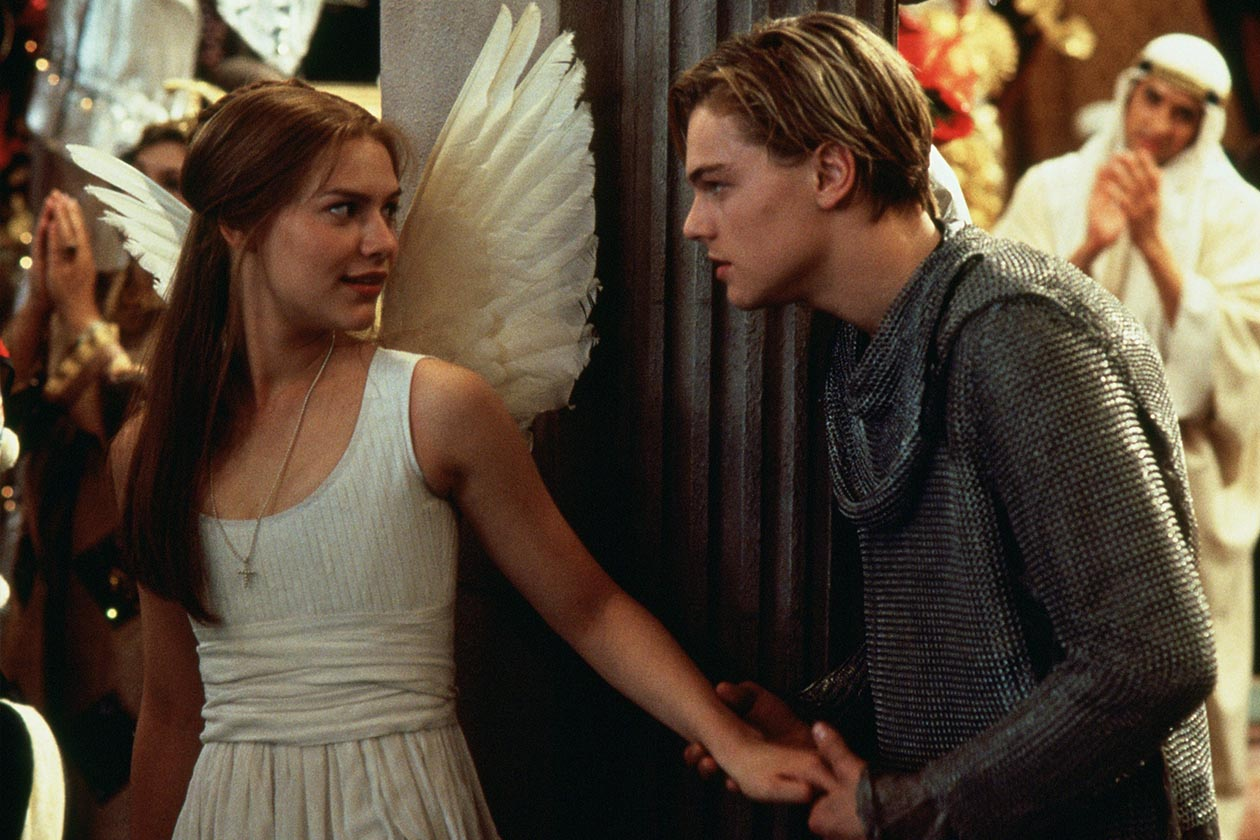
Since there are too many versions of Shakespeare on film to review in one blog post, I'll start with a play I remember vividly from my 9th grade English class: Romeo and Juliet. The Zeferelli film is gorgeous, but you will need to call a "bathroom break" after the marriage. While the kids are out of the room, fast forward through their honeymoon night. Marital relations are off-scene, but there is a shot of Romeo's naked rear-end when they wake up the next morning.
The Romeo+Juliet film is a modern version with guns instead of swords, full of energy.
In general, unless it is a Laurence Olivier black and white version, I suggest you preview a Shakespeare film adaption BEFORE watching it with your children. This is true ESPECIALLY if you watched it as a teenager. We often don't remember details that passed over our heads as teenagers. Trust me, they are much more vivid when you are sitting on the couch next to your young children!
The good news is that you can find plenty of options for free at your local library and on youtube.
Paid Resources for Shakespeare
Recorded Videos from House of Humane Letters:
Roman Roads Press
I taught a co-op class one year and the students found
this unit on Shakespeare very helpful. Like the other resources I've listed, these lectures help put the literature in historical context. The unit includes the following lectures, which average 30-40 minutes in length (and include more than just Shakespeare):
1. Introduction to Early Moderns (Wesley Callihan)
2. Introduction to Shakespeare (Peter Leithart)
3. Shakespeare’s Sonnets (Peter Leithart)
4. Shakespeare’s King Lear (Peter Leithart)
5. Shakespeare’s Richard III (Peter Leithart)
6. Shakespeare’s The Merchant of Venice (Peter Leithart)
7. Metaphysical Poets: John Donne (Wesley Callihan)
8. Metaphysical Poets: George Herbert and Marvell (Wesley Callihan)
9. Introduction to Milton (Wesley Callihan)
10. Paradise Lost I (Wesley Callihan)
11. Paradise Lost II (Wesley Callihan)
12. Paradise Lost III (Wesley Callihan)
One Last Note about Live Productions
Call the box office before buying tickets. Ask them if this particular production is family-friendly.
Yes, many theatres like to push the boundaries and politicize their story-telling. However, most theatres will post a sign that says "Adult Content" if they plan to have Macbeth set in the post-apocolypse doing drugs, with images of children being hanged in the background. Or nudity. I didn't take my children to see one production of King Lear because of nudity after reading about it in a newspaper.
The theatre companies want to please their patrons and don't want angry folks marching out of a show. They usually want to inform you to keep you happy.
I have found this to be very helpful. Also, you could just ask other people you trust about a particular theater's performances before buying tickets.
RICHES CLASS
I will be teaching an
online class at St. Athanasius Academy next school year. We will feast on the enrichment arts together, reading aloud two Shakespeare plays in class, as well as memorizing poetry, observing beautiful art, and listening to classical music. The class is on Fridays, if you are interested.
This post offers only a sample of the resources available. If you have specific questions about a specific play, feel free to ask!