Showing posts with label STREAM. Show all posts

Sunday, December 3, 2017

STREAM - Creation and Chocolate


STREAM - a little type of activity we do at our co-op class, incorporating {Science - Technology - Religion and Reading - Engineering - Art - Math} that you might like to enjoy with your children at home, in a classroom, or even at Vacation Bible School. I am not a STEM professional - my background is in English, Drama, and Debate - but that just proves that anyone can do science stuff if I can do it!  Consequently, please let me know how you improve the activities, as many combined minds often produce better ideas.

I don't teach like this most days, but sometimes a craft is in order! 

You could use the Children's Bible Reader, but the temple connected to our co-op has a set of lovely creation icons in the narthex, so we took a little field trip to observe those. I didn't get photographs, but here is a similar series.
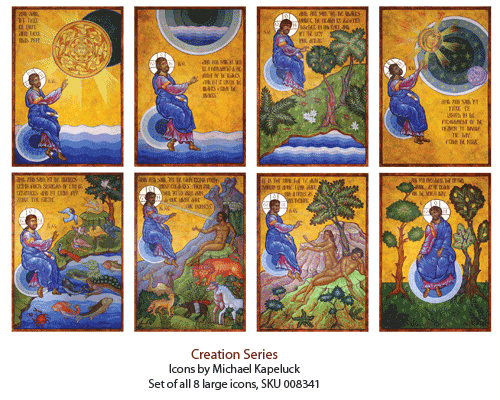


I asked the children what they saw and let them tell me all about it. We pointed out the water in the beginning of creation. And the earth. I explained that God made things to be in the states of solid, liquid, and gas when he created the earth, and that is what we are going to learn about today.

Solid
Liquid
Gas

Solids are hard, you can knock on them with your hand. Knock on the desk - is it a solid? Yes!

Liquids are runny and can pour. If we walked over to that water fountain and pressed the button, would the water pour out of the nozzle? That's right!

Gases are teeny tiny particles that float about and we can't always see them, but sometimes we can. Did you see your breath outside this morning when you walked to your car? That was a gas.

Let's practice. I'll show you a picture and you can put it in the right category: Solid, Liquid, or Gas.


The air inside a balloon?


The green cutting board?


The waterfall behind us?


The garden stone?

The children caught on pretty quickly, which was good because I was ready to get to the fun part of the lesson. You must have been wondering what any of this had to do with chocolate.

First, I sent them to wash their hands before we made cake pops balls. Then I brought out a package of melting chocolate and asked them if that was a solid, liquid, or gas? They knew it was a solid. We even knocked on it to feel how hard it was. But wait! Let's put it in the microwave for a minute or two! It helps to have an assistant for this. While the assistant melted the chocolate, which handily came in a microwavable container, I explained that we were going to make cake balls and we would start by crumbling up an entire cooked cake into a huge metal bowl and then mix those crumbs with some icing.

My high school Debate Team once made these to sell at lunchtime for a fundraiser, and I can tell you that these two flavor combinations were the favorites: 1) red velvet cake with cream cheese icing and 2) funfetti cake with vanilla icing. 


Since I had only three darlings doing the mixing, it worked for all them to have their gooey hands in the wide bowl at once. Then we rolled them into balls and placed them on paper plates. I do apologize for not having pictures of this, but my hands were pretty gooey too, too gooey to hold a camera. It was a requirement that I get in there and model how to do it, you know. They need to see it done - a great pedagogical truth for any subject, if only I would remember it all the time!


About this time, my assistant came back and showed us the melted chocolate. What is it now, children? Solid, liquid, or gas? As we spooned it up and watched it pour out, they all knew it was now in a liquid state. At this point, we glaringly separated ourselves from the professionals and just went for it, in several different methods, trying our best to coat each ball in chocolate. As we were trying very hard to do this, I remembered that it helps if you freeze the balls for an hour before trying to coat them in chocolate. Perhaps I should have re-read the instructions before doing the lesson - hmmmm. Also, I thought we had popsicle sticks in the craft cabinet but we did not! If we did, we would have inserted them into the balls and used them to facilitate dipping. Oh well, it mostly still worked for us.  I, for one, am proud of children's work that looks like children made it, as opposed to adults making it.

More importantly for you, if I can do STREAM activities or any arts and crafts projects - even with normal (for me) daily set-backs and teacher mistakes in planning - you can do it too!


We set aside our edible art until after lunch, to share with the rest of the students. We could not sell these junior varsity cake balls for a fundraiser, but we did make memories and the children loved the messy process. And that's what we are after in the long run, that the children learn to love science and God's wonderful universe.


Friday, November 10, 2017

STREAM - The Ravens of Farne

STREAM - a little type of activity we do at our co-op class, incorporating {Science - Technology - Religion and Reading - Engineering - Art - Math} that you might like to enjoy with your children at home, in a classroom, or even at Vacation Bible School. I am not a STEM professional - my background is in English, Drama, and Debate - but that just proves that anyone can do science if I can do it!  Consequently, please let me know how you improve the activities, as many combined minds often produce better ideas.

Science - natural science with birds and maps
Technology - if you are really interested in this, add an internet search*
Religion and Reading - St. Cuthbert and The Ravens of Farne
Engineering - you could incorporate the physics of flight and skeletal structure
Art - drawing by shapes and lines
Math - order of numbers in the index
The Ravens of Farne,** by Donna Farley, is a lovely tale about a monk living as a hermit on an island and the cheeky but repentant birds that keep him company.

First, I read the story aloud to my Kindergarteners and First Graders. Then, I ask them to take turns telling it back to me.

Afterwards, I turn to a page with many kinds of birds and ask the children to point out a raven in the picture. Yes, you are right! I write the word Raven on the white board. Let's find out more about ravens using our Field Guide to the Birds of North America. It tells us about all the different birds.

I flip through the field guide, allowing the children to see how many different birds are inside the book. There are so many - how can we find the raven? We can use the INDEX, which is organized by your A,B,C's. Let's say them now to review. (This is a fun and easy addition, because when a person is learning something new and perhaps difficult, it is nice to have an easy success to fuel things along.) Ok, let's look in our index - yes, there is the A, with all the birds that begin with the letter A.


 And then the B's,


and so on all the way through until...


We found the R's! Can you run your finger down the page until you find "Raven"? Only the first grader was game for that challenge. She had a reference for the spelling, however, because I had written it on the board earlier. Most everyone can answer the next question as I point to the page. What number is that? That is our page number, and the pages are in order, so let's find it!

We search through, starting with the lower numbers and moving up until we've gone to far and must go back. This is actually great math practice, though I admit the Kindergarteners were getting fidgety until...


Yes, you found it! That's it!!!!!

I mention that there are two kinds of ravens in the Field Guide but don't go into detail. You would know how much bird science to include or not at this point. Are your students ready to talk about RANGE and MIGRATION? We were not there yet when I did this lesson, because we had not been preparing for that beforehand. However, we had been doing map songs during circle time, so we do a little map skill work. We have been singing the states of the United States, so they were ready to point to our state. 
I explain that the purple area is where the birds can be found, and we realize that ravens are not in our state. Oh well. The Ravens of Farne was a book about an English saint, after all, on an Island off the coast of England, which is way across the ocean in Europe. (Another circle-time song, the continents and oceans.)

Let's observe that Raven in the picture. What do you see? I let them tell me as many details as they can, which is both an easy way to experience a little success after the more difficult map reading and also a preparation for our next activity. If beforehand you the teacher have read the Field Guide, this will equip you to help the children with new vocabulary when they point out something by describing it, not knowing that there is a word for that. You're right, Sammy, that tail is a WEDGE shape.

You know, being forethoughtful you probably would have told the children at the beginning that we were going to read a book, learn more about the birds in the book, and finally draw the birds. I think I did that. I will next time, for sure. Thanks for the idea!


Not being able to find a step-by-step example of how to draw a raven, I took my little non-artistic self and made one up. I tried to use the principle that most objects can be built out of smaller shapes and lines. The photo above is for my own reference, as I drew the shapes on our white board and erased bits as we went. The children's pictures turned out remarkably well.


End by asking them why we were wondering about Ravens in the first place - oh yes, St. Cuthbert! What do you remember about St. Cuthbert? Good! 

St. Cuthbert, pray for us!


There you go. STREAM.

Science - natural science with birds and maps
Technology - if you are really interested in this, add an internet search*
Religion and Reading - St. Cuthbert and The Ravens of Farne
Engineering - you could incorporate the physics of flight and skeletal structure
Art - drawing by shapes and lines
Math - order of numbers in the index


*to expand the map part of the lesson or even to do a google (you may prefer to use kiddle, a safer search engine for kids) image search for "ravens in the wild"* to see more pictures.  Just don't scroll down too far, though, because then the images will be of football players instead of birds. In fact, the first time I searched for simply "ravens," google produced almost entirely football related results.

This could be a great time to start teaching older children how to go about internet searches, especially about not giving up when the first search doesn't work. I almost always end up revising my search phrase once or twice based on the results I get. Walking through this process with the children helps them learn to do the same. When I first started teaching high school I was surprised when the students would quit searching after one try and tell me, "there's nothing good on my topic." After that, I walked them through a search of my own using the over head projector and taught them a little Boolean Logic before going to the library or computer lab with them.

**In fact, speaking of older children, the picture book above is a small tale in a larger young adult novel that my son loves, Bearing the Saint.


Thursday, November 2, 2017

Not STEM, Not STEAM, but STREAM

STREAM - a little type of activity we do at our co-op class, incorporating {Science - Technology - Religion and Reading - Engineering - Art - Math} that you might like to enjoy with your children at home, in a classroom, or even at Vacation Bible School. I am not a STEM professional - my background is in English, Drama, and Debate - but that just proves that anyone can do STEM if I can do it!  Consequently, please let me know how you improve the activities, as many combined minds often produce better ideas.


What is STREAM?

Science
Technology
Religion & Reading
Engineering
Art
Math

My purpose is for my children to approach science and math because those subjects allow us to wonder at the amazing and beautiful absolute truths built into God's creation, because those subjects help us understand our surroundings, because those subjects give them pleasure and enable them to achieve what God puts into their hearts to achieve.

Thanks be to God that the STEM initiative has trained many teachers to be able to offer more to their students and that more students - who perhaps did not have access to engineering and technology in their classrooms - are now more able to get it. Thanks be to God also for art and beauty, for goodness and truth.  If we highly train an army of scientists who can rule the world, but do not nurture their sense of what is good and true, we could train a villainous army indeed. Why not combine more than the original four STEM subjects and study things from a holistic viewpoint when possible?


A local magnet school does this and calls it STEAM, because they add Art. My local library also offers STEAM (STEM + Art) projects for students grades 3-5. I'm not generally a fan of project-based learning, preferring to let the children naturally make connections over a broad feast of books, art, nature study, ect., offered over the course of a lifetime. However, some occasions call for craft.

Therefore it was with sparked interested that I noticed the phrase STREAM on the website of a local Roman Catholic private school.  I appreciate that God is incorporated into the study, since He is the originator of the subject matter. I also like that Art is incorporated, since real beauty is the outward manifestation of spiritual truth. I personally added the extra "R" of reading, because I love stories and find that stories convey truths in a way that stick with children.

So where does this leave you?

If you have children in a public or private school, thank God for the good things they are getting and consider if you want to add any STREAM activities into your rainy days or summer fun.

If you teach in a classroom, thank God for the chance to work out your salvation serving kids and consider if you can or even want to integrate Art, Science, and Religion.

If you home school your children, thank God for the good things they are getting and consider if you want to add any STREAM activities into your days.


Why am I even thinking about all of this? Quite by accident. I was asked - despite my complete lack of experience in the subject! - to teach the Kindergarten/1st Grade Art and Science class at our Orthodox Homeschool Co-op.  At first I was going to do science one week, then art one week, but I felt more comfortable mixing them together. As the weeks have gone by, it has occurred to me that - at least for Kindergarten and First Grade - it is not too hard to create STREAM activities, or at least lessons that incorporate Science, Religion, Reading, and Art.